
The Seneca County Owner-of-Record Snapshot
The owner shown for a Seneca County parcel is an administrative field on the assessment roll. It is a starting point, nothing more. Save it alongside the parcel number, situs, mailing address, municipality, and roll year so the entry stays tied to the right property. The county points the public to Beacon for current property data. Portal screens change over time. Work with the fields actually shown on the card.
| Owner name | The primary or additional owner wording carried on the roll |
|---|---|
| Mailing address | Where tax correspondence is sent, not proof of residence |
| Situs | The physical property location used by the tax system |
| Parcel or SBL | The tax-map identifier used to reconcile sources |
| Roll or assessment year | The date context for the owner and value snapshot |
| Deed or sale clue | A reference to compare with the newest Clerk recording |
Confirm the Current Seneca County Owner Against the Newest Deed
Start in Beacon and search the parcel by address. Copy the owner field and parcel identifier exactly. Then open the County Clerk's I2 Real Property index, run the name as a grantee, and find the newest deed touching that same legal description. The recording date, grantor, grantee, and property description must line up with the assessment record. A name alone is not enough. People and entities share names, so the parcel or description is what ties the deed to the land.
- Capture the tax-card owner, situs, parcel number, and roll year.
- Search the owner as Grantee and Both in I2.
- Open the newest deed image available for the parcel.
- Match the legal description and date sequence.
- Ask the assessor and Clerk about an unresolved difference.
Situs is the land. Mailing address is where mail goes. The assessment roll is the tax administration list. The owner of record is the name carried in the governing official record, and recording lag is the gap before separate systems reflect a transfer.
How Current Is a Seneca County Owner Record?
A recorded deed can appear before the tax roll reflects the closing. Historical Seneca County system documentation described owner files updated periodically and sent for master updates. The county publishes no fixed number of days. So never promise a lag. Compare the deed's recording date with the roll year and any sale field, and call the assessor if the card still names a prior owner.
The reverse situation also needs care. One deed may transfer only a partial interest, create a life estate, place land in a trust, correct an earlier instrument, or affect property that no longer matches the current tax parcel. Read the whole instrument. The later deed is more current for the recorded conveyance. The tax office still controls its own administrative owner file. Ask that office when the next roll update will appear.
Recent-sale rule. When the roll and deed conflict, preserve both dates and ask the custodians; never choose an owner by assumption.
Trusts, LLCs, Estates, and Multiple Seneca County Owners
A Seneca County parcel can name a trust, estate, corporation, LLC, fiduciary, or several individuals at once. Search the exact recorded style. Try punctuation variants and any human trustee or executor named in the deed. For a business entity, the New York Department of State database can confirm the entity name, formation jurisdiction, county location, status, service address, and publicly available agent information. None of that reveals every beneficial owner. An agent is not the landowner either.
Estate transfers need probate context plus a recorded conveyance. Search the decedent, estate, executor, administrator, trustee, and beneficiary in I2, where labels like letters testamentary, executor certificates, wills, trusts, death certificates, affidavits, and transfer-on-death filings appear. WebSurrogate or the court file explains who held authority. The deed or recorded estate instrument still confirms the transfer. Match every document to the parcel before drawing conclusions about ownership.
Situs and Mailing Address Answer Different Owner Questions
Situs locates the land. The mailing address is where correspondence goes. It may be an out-of-state home, a post office box, a business office, an attorney, a fiduciary, or a service company handling mail. Neither address proves residence. Only a record that actually establishes residence supports that claim. A Waterloo, Ovid, Interlaken, or Seneca Falls postal label does not necessarily define the parcel's town or village jurisdiction.
New York's Address Confidentiality Program supplies a substitute address and mail forwarding for eligible protected participants. Confidential voter registration is a separate safeguard. Treat withheld information as legal protection. Current-owner research stays with the public owner field, the recorded conveyance, and the parcel identity rather than attempts to reverse engineer an address.
Property Fraud Alerts Help a Seneca County Owner Monitor Names
The County Clerk links a free Property Fraud Alert. The service monitors a registered individual or organization name for later filings in participating counties. A 2025 county warning described false electronic proof of ownership used in attempted property listings. The alert is only a prompt. It cannot prevent recording. It cannot verify title. It cannot replace review of the indexed document. Check any notice through an independently verified Clerk contact. The service's registration page shows the county list and the monitored-name sign-up. Then inspect the filing itself.
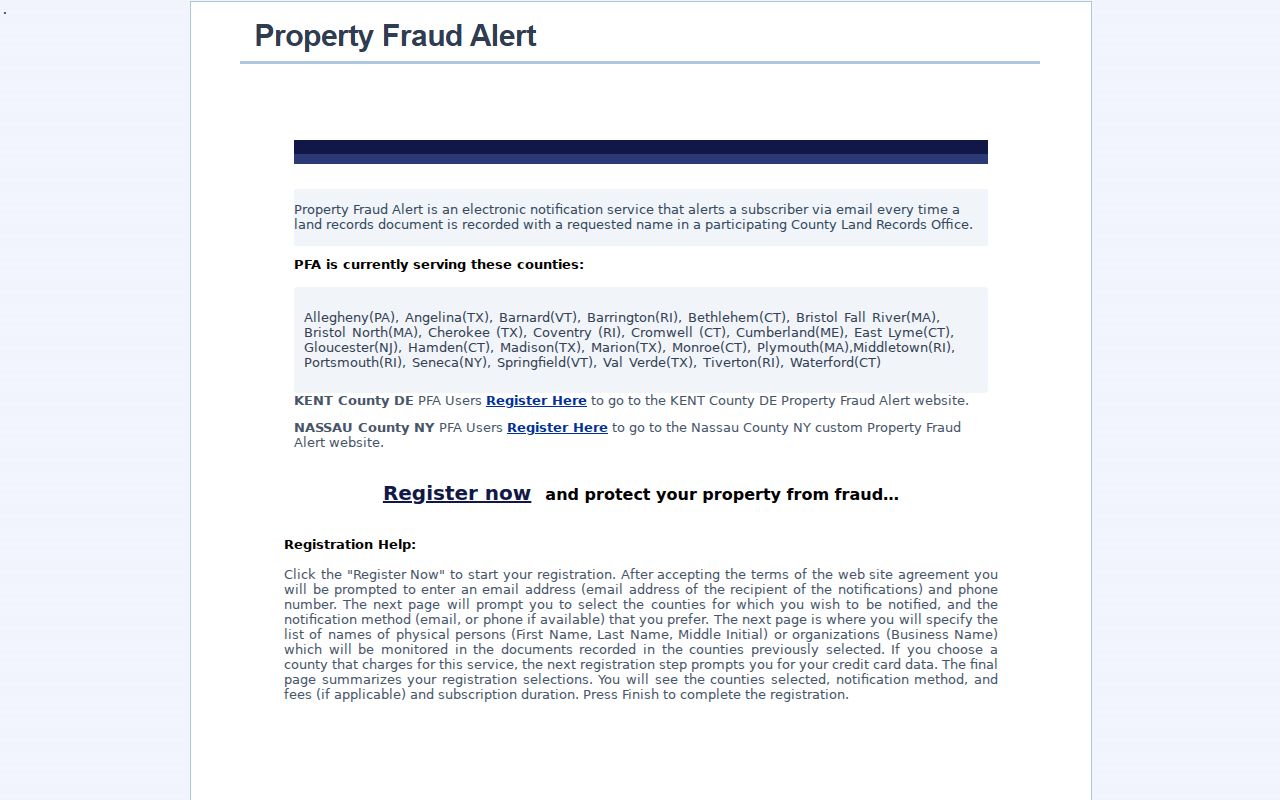
Seneca County owners can pick the right alert service, and an alert is only a prompt to investigate further.
When the Seneca County Parcel Card Is Unavailable
Start with the Real Property Tax Department and the town assessor handling the parcel. Give them the street address and the owner name. Include the parcel number if you have it. Also give the municipality and the roll year you want. Request the current roll entry or an archived roll, not a fresh analysis. The County Clerk can also pull the latest recorded deed by party and document reference. A New York FOIL request can reach other county or municipal records that are not exempt.
New parcels need extra care. After a lot split, merger, or subdivision, ask Real Property Tax about the tax-map history. Ask how the change takes effect on the roll. Then retrieve the recorded deed, boundary agreement, or subdivision document itself. Web cards sometimes vanish after a parcel event. The ownership trail in the recorded Seneca County property records still holds.
What a Seneca County Current Owner Result Does Not Prove
The result names the owner of record. That is all it does. It does not prove someone lives there. It does not reveal beneficial owners behind an entity. Nor does it guarantee clear title, clean boundaries, or freedom from liens. A current owner result will not confirm a permit was closed out. It will not show that a mortgage balance went unpaid. Treat it as one dated finding. It works well for due diligence, deed confirmation, notices, estate research, and public accountability. Just tie the conclusion to its source and date.
Starting from an address you do not recognize? The Seneca County owner-finding method lays out the wider sequence for that job. This page stays narrower: verifying the name on the present roll.
Record the Present Seneca County Owner With a Date Stamp
Record what you see before it changes. Note the roll date, owner field, mailing address, situs, parcel number, municipality, and assessment year. Do this on the day you search Seneca County property records. Then add the newest deed's grantee, recording date, instrument reference, and legal description. A dated note built from both sources stays readable after either system updates.
When the records disagree, ask narrow questions. Ask the assessor which roll the public card reflects. Ask whether a deed update is pending. Ask the Clerk about the deed records. Ask whether a newer conveyance, correction, or estate instrument exists there. For an entity, confirm its exact name through the New York business database. But do not guess at hidden beneficial owners. For a trust or estate, keep the legal capacity shown in the instrument.
Phrase the result as a source finding. The assessment roll named a party as of a stated year. The newest deed recorded a grantee on a stated date. That wording beats any claim of permanent ownership. It also makes later verification easy. The next searcher can check the same parcel, roll, and deed records and compare.
A later search can honestly return a different owner. A deed may have recorded. A roll may have updated. Or the parcel itself may have changed. Keep the earlier result instead of overwriting it without a date. Comparing the two often explains the transition. It also points to whichever office holds the newer record in the Seneca County property records.
For notice or due-diligence work, verify the owner again close to the action date. A saved card goes stale after a deed, an estate transfer, or a parcel event. The fresh check should reuse the same parcel number. It should also reuse the legal-description controls from the original property search.