
What Seneca County Deeds Record
A Seneca County deed records more than a simple sale. The word covers several legal forms of land transfer. Whatever the form, the County Clerk records the instrument and indexes its parties. Recording does not guarantee clean title, though. It simply makes the transfer part of the public record. Start your property search with the newest conveyance for the parcel. Note the grantor, the grantee, the recording date, the document reference, and the legal description. Then follow those names backward through the deed records. Trust the legal description over a modern street address. Land in Seneca County has been split, combined, and renumbered over the years, and old records may describe a parcel by a road, canal, monument, lot, or boundary call instead of a house number.
| Deed form | What it generally does | Useful research question |
|---|---|---|
| Warranty or bargain-and-sale deed | Conveys the grantor's interest with the covenants stated in the instrument | Who acquired the parcel and what description passed? |
| Quitclaim deed | Transfers whatever interest the grantor has without promising the quality of title | Was a family, boundary, or ownership interest released? |
| Executor or administrator deed | Transfers estate property under documented authority | How did an estate place the parcel with a later owner? |
| Transfer-on-death filing | Creates, revokes, or documents a death-related transfer route | Which later instrument completed the ownership change? |
| Boundary or easement instrument | Defines access, use rights, or an agreed line without necessarily conveying the whole parcel | What recorded right affects the land? |
Search the Seneca County I2 Grantor-Grantee Index
Seneca County keeps its deed records online. They live in the Clerk's 20/20 Perfect Vision I2 portal. Real Property index entries and images reach back to June 1967. The Name Search form asks for a business or last name, with an optional first name. It also lets you fill two party rows. You can narrow by role, choosing Both, Grantor, or Grantee. Filter further by document type and by recorded date. Begin with Both and a wide date span. Run the search again as Grantee to trace acquisitions. Then run it as Grantor to catch later transfers out. Before concluding a deed is missing, test initials, spouse names, trusts, estates, and full entity names. Surnames and entity spellings shift across decades, so one spelling rarely tells the whole story.
The official I2 portal displays the live name-search controls along with its current coverage notice.
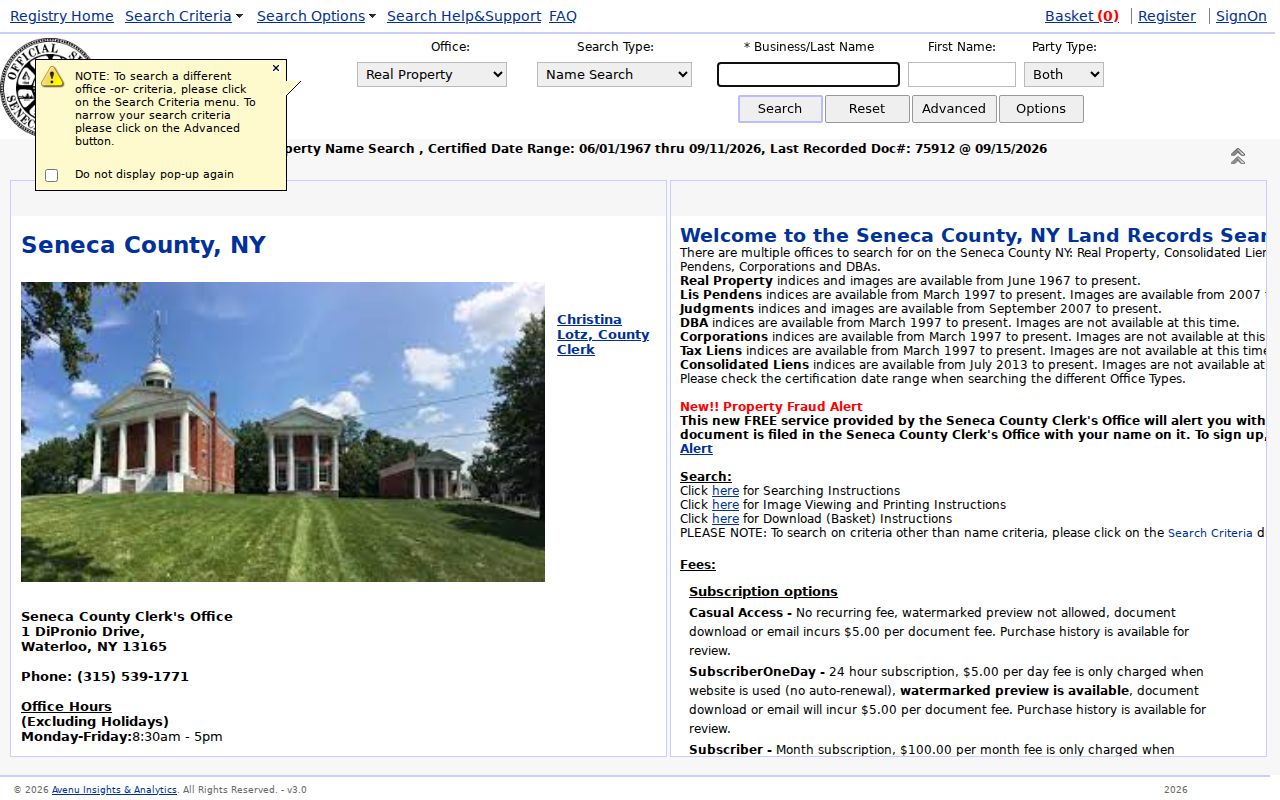
The screen is only an index entry point. A search result and a deed image still need to be read together.
Build a Seneca County Chain of Title One Link at a Time
Take the newest deed reference from the current parcel or from an I2 grantee search. Read the instrument closely for the exact grantor and the legal description. Then search that grantor as a prior grantee. That is how you find the deed. It is the one by which the person or entity acquired the same land. Repeat the process link by link. Check that the description, acreage, lot, easements, and adjoining-owner calls stay consistent as you move back through the Seneca County property records. Common surnames call for extra controls. Use the spouse, the mailing address, the entity name, the recording sequence, mortgage references, and the property description to confirm each match. A chain of title is not sound on surnames alone. One surname following another in consecutive deed records proves nothing.
- Open the newest recorded conveyance for the parcel.
- Copy its grantor, grantee, date, and full book/page or instrument reference.
- Match the legal description to the current parcel.
- Search the grantor as grantee in an earlier period.
- Repeat until the online cutoff, then move to the historical index.
In a Seneca County deed record, the grantor conveys the parcel and the grantee receives it. A chain of title is simply the sequence of those transfers strung together, owner to owner, across the county's deed books.
Seneca County Deed Books Predate the Online Cutoff
Seneca County deed records run far deeper than the online cutoff. June 1967 is simply where the practical I2 starting point sits, not where land recording began. The FamilySearch catalog covers deed records from 1804 through 1904. It also includes an index reaching to 1967 across 83 microfilm reels copied from courthouse originals. The BGSU Center for Archival Collections holds a finding aid. It lists deed indexes, plat and survey material, tax lists, and court records with overlapping historical runs. Got a book and page citation? Carry it backward through those collections. Remote images may be restricted. Ask about access at a FamilySearch location, the Clerk's office, or the holding archive.
The county itself dates to 1804, carved from Cayuga County. Ovid served as the first county seat, according to official county history. Court functions moved to Waterloo in 1817. That explains why older references may point to Ovid. Today's courthouse record route runs through Waterloo. No courthouse fire destroyed the county land books. Treat any unexplained gap as a research problem. Work through spelling variants, indexing quirks, estate files, partitions, and archive routes. Skip the loss story.
Read Mortgages, Releases, and Easements Beside the Deed
A deed never tells the whole story of a parcel. The Seneca County clerk records many instrument types alongside conveyances. These include mortgages, assignments, discharges, releases, easements, rights of way, covenants, boundary-line agreements, trusts, death certificates, and executor filings. Pull a mortgage under both the borrower and the lender. Then trace it forward. Look for any assignment and a final discharge. An old mortgage entry alone does not prove money is still owed. Search the exact legal description too, and follow the cross-references inside the images. An easement or boundary agreement can still bind the land after several ownership transfers.
Other encumbrances sit in separate offices. Lis pendens, judgments, tax liens, consolidated liens, DBAs, corporate filings, and UCC material each have their own portal office. Date and image coverage differs from office to office. Lis pendens indexing begins in March 1997, and images start later. Judgment coverage opens in September 1997 for indexes and images alike. Some offices provide indexes without images. A careful deed review in Seneca County therefore checks each relevant office. Treating Real Property results as the full encumbrance picture misses the rest.
Estate and Court Records Can Explain a Broken Deed Sequence
When a Seneca County owner dies, the chain may expect a deed. No ordinary arm's-length deed may appear. Search more than the decedent's name. Executors, trustees, and later grantees matter too. The I2 index carries document labels for wills, letters testamentary, and certificates of executor. Trusts, death certificates, and transfer-on-death instruments appear too. So do releases of estate tax and affidavits. WebSurrogate or NYSCEF can then explain who held authority over the transfer. The right Surrogate's Court file may do the same. The recorded executor or administrator deed still anchors the land record itself.
Foreclosure, partition, and quiet-title actions break a simple grantor-grantee path as well. Search the I2 lis pendens office and New York eCourts. Read the disposition, then locate any referee, sheriff, or later transfer deed. The portal family shows where court researchers begin.
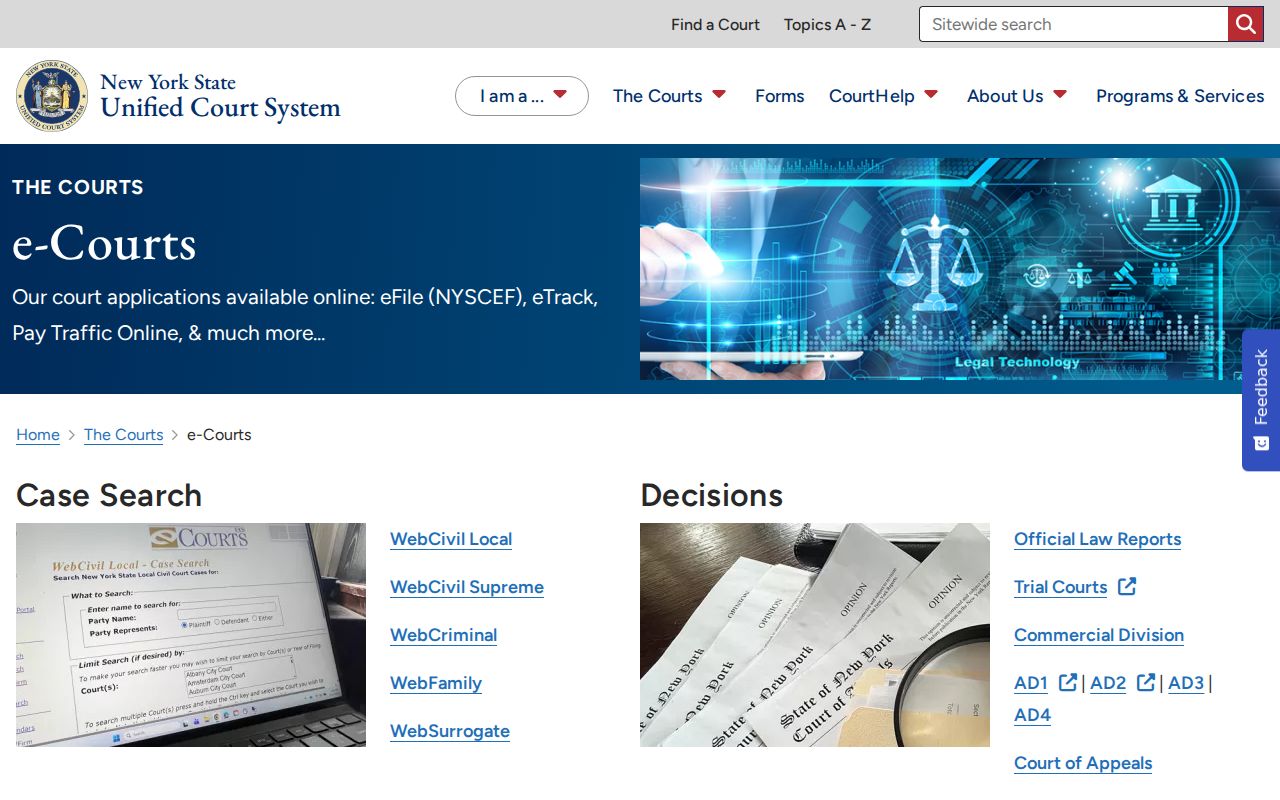
A docket entry is only a lead, never proof.
Order a Seneca County Deed Copy From the Correct Reference
Gather the essentials before requesting a Seneca County deed copy. Party names, document type, and recording date all belong on the request. So does the exact book/page or instrument number. An ordinary copy ran $0.65. A prepared certified copy cost $5. Another copy category ran $2. Exemplification added $15 when researched. Recording fees are separate, built from cover, page, index, and state-form charges. Fees change. Check the current Clerk schedule before sending payment or relying on an old amount.
Match the copy type to the task. An index result works for discovery. An ordinary image lets you read the parties and the property description. A certified copy authenticates the Clerk's record when a purpose demands certification. None of these is a legal opinion on title. If the image is not online, ask the Clerk for the indexed instrument. Do not assume the filing lacks content.
Recorded is not guaranteed. Seneca County deed records show what was filed and indexed; they do not certify clear title, resolve a boundary, or replace a lawyer's title examination.
Use Historic Maps and Directories to Interpret Old Descriptions
The county maps page is a good first stop. It covers Ovid, Waterloo, Seneca Falls, and other nineteenth-century town and village maps. NY Heritage's directory collection and Seneca Falls Library's local-history resources can tie an earlier street name, business, occupation, or occupant to a modern site. Interlaken takes special care. It appeared as Farmerville, Farmer, or Farmer Village. Lodi Street, meanwhile, later became West Avenue. These sources sharpen your search terms, but they cannot turn an occupant into an owner or a drawn line into a surveyed boundary. Every historical clue belongs back in the recorded legal description. It must also rejoin the grantor-grantee chain. For a broader address-to-parcel route, use the Seneca County property search guide; this deed page stays focused on instruments and recorded transfers.
Prepare a Seneca County Deed Research Packet
Come with the current address and parcel number. Include the municipality, owner and prior-owner names, and approximate transfer year. Add any known instrument or book/page reference. For an older chain, include the last confirmed I2-era deed. List every spelling variant already searched, too. Clerk or archive staff can then start from a concrete index point. They will not need to rebuild your whole question.
Transcribe names, dates, and descriptions exactly as written. Note exceptions, reservations, easements, life estates, trust capacity, and references to earlier deeds or maps. When a conveyance covers several tracts, identify which tract matches the current parcel. If certification is needed, ask for the specific recorded instrument rather than a general ownership report.
Read the whole deed, not just the first page. The acknowledgment and recording block matter too. The execution date, the acknowledgment date, and the recording date can all differ. Those gaps often mark the real timeline of a property records search. Treat a return address or tax-form reference as a clue only. Never treat it as proof of residence. Marginal notes, correction references, and map citations deserve attention as well. They can point to a later filing that changes how the instrument reads.
For everyday research, keep the index screen and the full instrument together. A court, lender, or agency demanding a certified copy should confirm that requirement first. Do this before you order. Certification authenticates the Clerk's copy of the deed records. It does not turn the deed into a title opinion.