
Choose the Seneca County Record That Answers the Question
Match the question to the right record first. Ownership transfers live in the deed and its grantor-grantee chain. The roll gives the current administrative owner and the assessed value. Bill and payment questions go to the collector or Treasurer. Parcel shape starts on the tax map. Deeds, plats, and surveys prove the boundary. Permits stay with the office that processed the project. Court files explain litigation. The later deed or release shows what reached the land record.
This division is what keeps Seneca County property records dependable. A mortgage entry is not a balance statement. A lis pendens is not a finished foreclosure. A directory occupant need not be the owner of record. Zoning districts do not prove permitted use at one address. A historic map does not fix the current line. State the narrow fact each source supports. Then call the next custodian only when the question requires it.
For long-term work, keep a citation log. Record each portal, query, date, document reference, map year, roll year, and copy source. Logs matter most with entity names and estates. They also matter with Interlaken's former place and street names. Ovid's early county-seat references belong in the same habit. The log shows why a later researcher reached the same parcel. It also marks where an unresolved gap remains.
Match Seneca County Property Records by Date and Parcel
Strong results reconcile sources, not one screen. Write down every date. Note the assessment roll year, the deed recording date, the tax-bill year, the map date, and the permit date. A roll can still list a prior owner after a deed records, and a bill can cover a tax period before a transfer. A historic map may preserve a road or canal label the postal address no longer uses, and dates kept beside each fact stop normal update cycles from reading as contradictions.
Parcel changes need the same care. A split, merger, boundary agreement, or subdivision can create a new tax-map number while older deeds keep the parent description. Ask Real Property Tax about parcel history. Follow the land through Clerk instruments after that. Never join records on a shared street number or surname alone.
Prepare a Focused Seneca County Records Request
Some images, permits, old rolls, and maps never reach the web, so ask for them directly. Supply the current and any historic address. Add the parcel number, municipality, present and prior owner names, approximate dates, and the exact record type. State whether inspection, an ordinary copy, or a certified copy is needed. For deeds, include the instrument or book/page reference. For permits, name the project and request plans, conditions, inspections, and certificates.
Get a fee estimate before ordering a large file. Use the custodian's current instructions. New York FOIL reaches existing agency records subject to exemptions, but it does not require staff to run a title search, draw a boundary, appraise property, or build a new report. A parcel-specific request is easier to reproduce. It is also less likely to mix records from different people or places.
Begin a Seneca County Property Records Search With Three Keys
Start with three keys. An address, an owner name, or a parcel number anchors the search. The county posts current assessment data through Beacon, while recorded transfers sit in the County Clerk's I2 land-record index. Verify the postal form of the address first. Open the parcel record. Save the tax-map identifier exactly as displayed. Then compare the owner field with the newest deed, since the roll is an administrative snapshot that may lag a recent closing.
- Search the current parcel by situs address.
- Save the parcel number, municipality, roll year, and owner field.
- Search that owner as grantee in the deed index.
- Compare dates and legal descriptions.
- Request an official copy when the index or image is incomplete.
The Seneca County Clerk's Digital Land Index Starts in 1967
The 20/20 Perfect Vision I2 portal is the main online index for Seneca County deeds, mortgages, assignments, releases, easements, rights of way, liens, trusts, and estate documents. Images and indexing begin in June 1967. Name Search requires a business or last name. A first name, party type, document type, and recorded-date range are optional filters. Run a broad Both-parties search first. Then repeat spelling, initials, trust, estate, and entity variants before narrowing to Grantor or Grantee.
| Search field | How it helps | Local caution |
|---|---|---|
| Party name | Finds people, trusts, estates, and entities | Search spelling and suffix variants |
| Party type | Separates grantors from grantees | Use Both for the first pass |
| Document type | Narrows deeds, liens, releases, and easements | A narrow filter can hide related filings |
| Recorded date | Focuses a known transfer period | Recording and closing dates can differ |
Older Seneca County Deeds Continue Beyond the Web Portal
The portal's cutoff is not the beginning. The FamilySearch catalog describes Seneca County deed records from 1804 through 1904. It also lists an index from 1804 through 1967. Both sit on 83 microfilm reels made from courthouse originals. The BGSU Center for Archival Collections finding aid adds historical deed indexes, plats, surveys, tax lists, and court material. Work backward from a known modern deed. Stop when a book and page crosses the digital cutoff. Then switch to the older grantor-grantee index. A missing online hit does not mean no transfer occurred.
Seneca County Property Records Come From Separate Custodians
No one office in Seneca County holds a full parcel history. The pieces live in different drawers. The County Clerk records deeds, mortgages, and other conveyances. Those recorded instruments anchor most ownership questions. The Real Property Tax Department keeps the tax maps and pulls assessment data together. Local assessors maintain the roll information for their municipalities. The Treasurer and town or village collectors handle tax billing at separate stages of the cycle. Permit and zoning files sit with village, town, or county offices. For older occupants, maps, directories, and past building use, the County Historian, libraries, and archives are the right stops. Treat that historical material as discovery evidence, though, not as proof of title.
County Clerk
Recorded deeds, mortgages, releases, easements, liens, judgments, and copies.
Real Property Tax
Assessment coordination, tax maps, current parcel search, and assessor contacts.
Treasurer and collectors
Tax bills, collection status, historic reports, and municipal collector routing.
What Seneca County Parcel and Tax Records Contribute
A parcel card ties a physical address to an owner file, a mailing address, a tax-map number, an assessment year, land value, improvement value, exemptions, and legal-description clues. Field labels in the live Beacon record can change. So read what is visible and note the roll year. Two terms trip people up. Situs is the physical location of the land. The mailing address is where tax correspondence goes. A distant mailing address does not prove vacancy. A shared surname does not prove anyone lives on the parcel.
Parcel number: the tax-map key that links assessment and map records. Owner of record: the name carried on the current administrative roll. Legal description: the deed language identifying the land. Plat: a recorded or approved map of lots and rights.
Seneca County Maps Require an Honest Manual Workflow
Seneca County publishes no interactive parcel viewer with an adjacent-select or buffer tool. The official county maps collection offers current and historic town and village maps. Beacon serves as the county-linked route for parcel data. Studying a block takes patience. Identify the subject parcel first. Then read each touching tax-map identifier from the available map. Search those identifiers one at a time. Remember that tax-map lines are for reference only. They do not settle disputed boundaries. They do not replace a filed plat or substitute for a licensed survey.
Waterloo, Interlaken, and Ovid Are Village Record Lenses
Seneca County has no incorporated city. The 2020 Census table lists Waterloo, Interlaken, and Ovid as villages. Those three anchor the local page set. Core deeds and county assessment data stay in county hands. Local offices route zoning, permits, and village tax questions. Waterloo raises its own map questions. They are shaped by Main Street, Virginia Street, Oak Island, the canal, and the river. Interlaken searches must cover Farmerville, Farmer Village, and the former Lodi Street name. Ovid's early county-seat history and its historic village maps leave a different archive trail.
A Free Seneca County Recording Alert Addresses a Local Risk
The County Clerk links a free Property Fraud Alert. The service watches a registered person or organization name for later recordings in a participating county. It earns its keep here. A 2025 local warning described attempted listings backed by fake electronic proof of ownership. An alert can flag that kind of filing early. Keep the service in perspective, though. It is an alert. It is not a recording block, a title insurance policy, or a legal finding. When an email arrives, open the indexed document. Then reach the Clerk through an independently verified channel.
The official registration screen shows how the service selects a county and a monitored name.
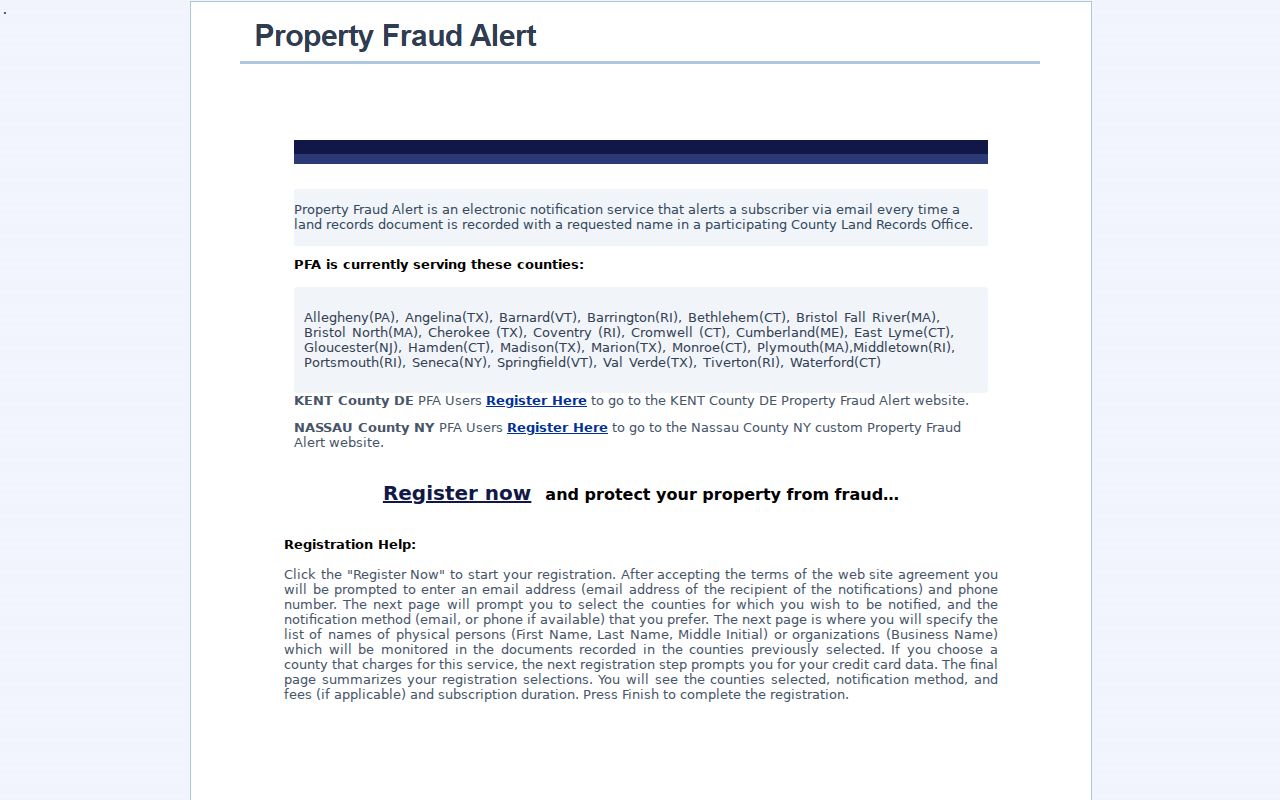
The capture helps users recognize the correct service before supplying an email address.
Historic Maps and Directories Add Context, Not Title
The county map holdings include Ovid, Waterloo, and Seneca Falls village sheets. They also include nineteenth-century county and town views. NY Heritage describes a 53-item Seneca County directory collection. Seneca Falls Library lists directories, newspaper scrapbooks, Sanborn maps, county histories, and HeritageQuest. These sources can link a prior occupant to a building. They can also link a business, an old road, or a former street number. Pair every historical hit with a tax parcel and a recorded deed. A directory can show who was associated with an address. It cannot prove ownership.
The NY Heritage directory collection provides the source for the following view.
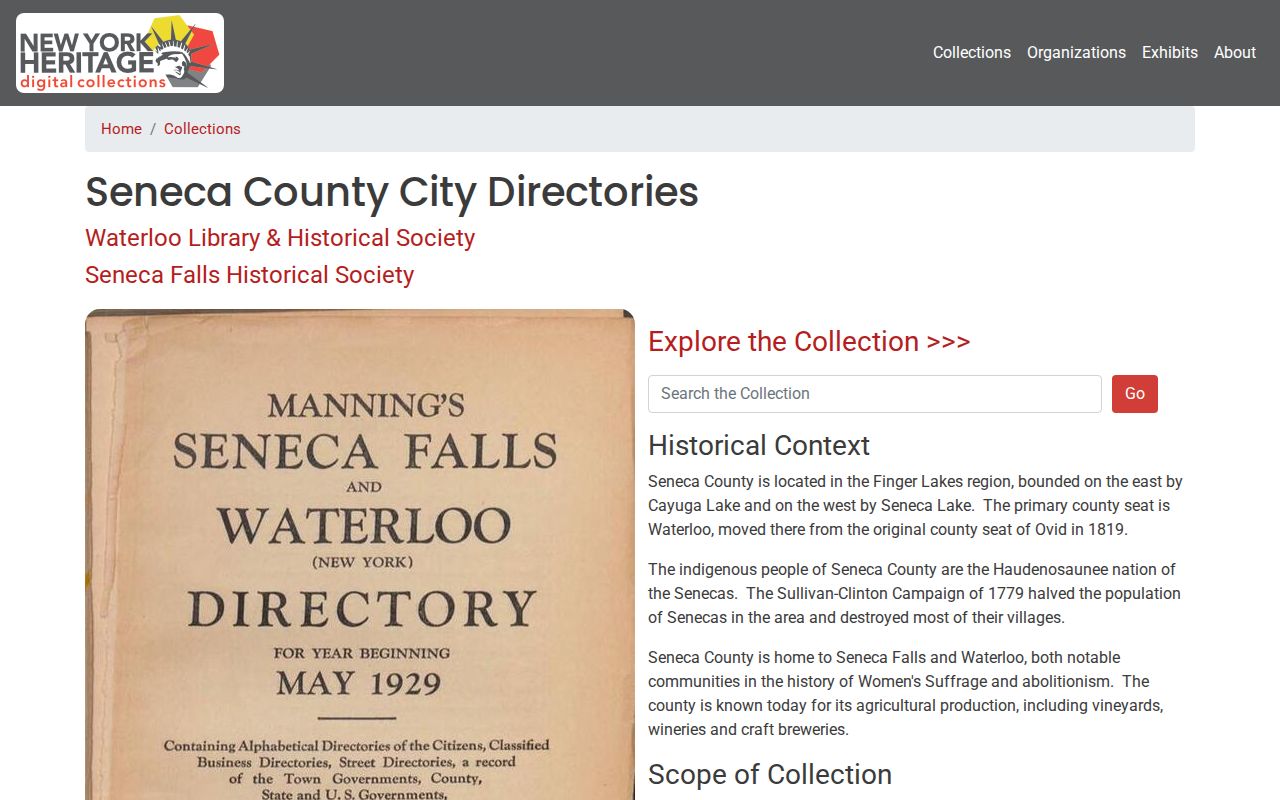
Its Waterloo and Seneca Falls runs can connect an older address to a deed or a tax search.
Tax Bills, Assessments, and Sale Prices Answer Different Questions
Assessed value is the local roll figure used for taxation. Market value estimates what the property could sell for under normal conditions, while recorded consideration is the amount reported for one particular transfer. New York equalization ratios describe municipal assessment levels in aggregate, and they will not convert every parcel into a reliable sale price. Historic bills and status reports run through the county-linked Total Collection Solution workflow. Current review and grievance steps follow the local assessment calendar and the Form RP-524 process.
FOIL and Office Requests Fill Seneca County Online Gaps
New York's Freedom of Information Law lets you request existing county or municipal records that are not conveniently posted. Exemptions and redaction can apply. An agency generally must grant, deny, or acknowledge a request with an approximate determination date within five business days. The clock is short. Describe the parcel, address, owner, date range, and record type. State whether you want inspection, an ordinary copy, or certification. FOIL cannot force an office to create a new analysis or answer a title question. For historic work, the County Historian, the FamilySearch catalog, and the BGSU finding aid are often better first routes. Library collections are another good starting point.
Limits of Seneca County Property Records
Public records can be stale, incomplete, indexed under a variant, or restricted. Protected Address Confidentiality Program information and confidential voter records must never be reconstructed or republished. Read each record with care. A tax owner is not necessarily an occupant. A permit does not prove work was completed. An open mortgage index entry does not prove a balance remains. A foreclosure notice does not prove a sale closed. Reconcile each claim with the document that actually answers it.
Use records lawfully. A Seneca County property records search is not a title examination, appraisal, or boundary survey, and owner information must never be used to harass or harm anyone.
Practical Seneca County Evidence Combinations
A purchase-history question usually takes three records. The newest deed names the recorded grantee and gives the legal description. The assessment roll supplies the parcel and value context, and the tax bill shows the charge for a stated year. Canal, river, former rail, or private road borders call for the recorded easement and map references. A changed building use points to the permit or planning file. Directories and Sanborn maps add context.
An estate question runs in a different order. Start with the deceased owner and the parcel, then search Surrogate's Court for the grant of authority. Look for executor, administrator, trust, affidavit, or death-related filings. The eventual deed confirms the transfer. A foreclosure question layers lis pendens, the court docket, a judgment or discontinuance, sale material, and the resulting deed or release. Each source contributes one fact, so none deserves promotion into a complete ownership conclusion.
Municipal structure also shapes the search vocabulary. Waterloo serves as county seat and remains a village. Interlaken keeps former settlement and street names, Ovid carries early county-seat references, and Seneca Falls adds former-village and town context. A postal city, an incorporated village, a town, a tax roll, and a zoning office can each describe overlapping but different geographies. Preserve the municipality printed on the parcel record. Ask the local office to confirm current jurisdiction.
For historic buildings, combine the FamilySearch deed index, county maps, NY Heritage directories, library newspaper and Sanborn holdings, and County Historian material. Let an archive source generate names and addresses. Then return to deeds and tax records for confirmation. This two-way method keeps an old occupant, business, or map label from being mistaken for the legal owner of record.
A changed portal calls for a fresh start. Begin again from the custodian page, not an old bookmark. Record the new link if you like. But keep the document reference, parcel number, and saved copy from the earlier search. Those stable identifiers let the Clerk, assessor, collector, or archive pull the same record. This works even after a vendor interface changes. They also separate a true coverage gap from a broken link. Or they flag a temporary access problem. Let the official county or state page launch every renewed search. Vendor names and interfaces come and go. The custodian and record reference remain durable. If a saved link fails, confirm the office route before concluding that public access ended.