
Fields That Make Up Seneca County Property Tax Records
A Seneca County tax record has three layers. The roll describes a parcel for taxation. A bill applies county, school, and municipal charges for a tax period. Collection status shows payment. An owner name alone can go stale or attach to the wrong parcel, especially when a transfer closes between roll updates. Note the roll year and bill year. Attach the municipality and parcel number too, because those fields are what keep Seneca County property tax records straight.
| Tax field | What it tells you | Where to verify it |
|---|---|---|
| Parcel or tax-map number | The administrative key for the land | Beacon, tax map, or assessor |
| Land and improvement assessment | Components of the assessed total | Current assessment roll |
| Exemptions | Adjustments shown for qualifying property | Assessor and roll entry |
| Taxable value | The base used after applicable adjustments | Roll and bill |
| Bill and payment status | Charges, installments, or recorded status for a tax year | Collector, Treasurer, or TCS report |
Find Current Seneca County Assessment Data Through Beacon
Seneca County routes its public tax-data search through Beacon, and the county's Real Property Tax Department page links to it alongside assessor contacts. Beacon accepts an address, owner, or parcel. The live screen shows the exact labels and optional fields. Fields worth saving include the owner of record, situs, mailing address, parcel identifier, assessment year, land value, improvement value, total assessed value, exemptions, and any sale or legal-description data displayed.
Each entry is an assessment record, not a deed. Historical county system material described periodic owner-file updates. No current Seneca County source gives a fixed number of days between a closing and the roll update. Ownership questions should still be checked against the newest recorded deed in the County Clerk's deed records. Note the roll year. A later screen can change. A saved number loses its context without the year attached, so pair the parcel number with the roll year.
Use TCS and the Correct Collector for a Seneca County Tax Bill
The county links Total Collection Solution with a usage guide. The guide covers historic bill and parcel-status reports. Current collection splits among town or village collectors and the County Treasurer. The responsible office depends on the tax and collection stage. Check the taxing municipality on the parcel record first. A postal city can mislead. It does not always name the responsible town or village. An office mailing address likewise is not the situs of the parcel.
- Find the parcel number and municipality in the current roll.
- Select the bill, entity, or report route described in the county TCS instructions.
- Choose the correct tax year and verify the parcel identity.
- Read charges, adjustments, and status in the context of that year.
- Contact the listed collector or Treasurer when a payment, delinquency, or transfer is unclear.
An assessment is the value placed on the roll. Taxable value reflects applicable treatment before rates apply. A levy is the amount a taxing authority raises for its budget. A tax lien is a legal claim against the parcel and belongs in the proper tax and recorded-lien sources.
Assessed Value Is Not a Seneca County Sale Price
New York's equalization rate is assessed value divided by market value at the municipal level. The ratio supports tax equalization. It does not appraise one address. A 2024 state survey lists Waterloo near a 68 assessment ratio, Seneca Falls at 100, and lower aggregate ratios in the south-county rows. Two assessed totals are not market value. Use the municipality, roll year, property class, and local level of assessment instead.
A recorded sale price answers a different question. The RP-5217 transfer report accompanies the deed and carries sale and property details. The deed and transfer material may show consideration. A family transfer, estate matter, or partial interest may not be a fair market comparison. Keep the three dates separate. An assessment, transfer consideration, and independent appraisal can all differ while every record is right.
The state transfer-reporting page explains the form and how a reported sale should be read. It is the official route for that context.
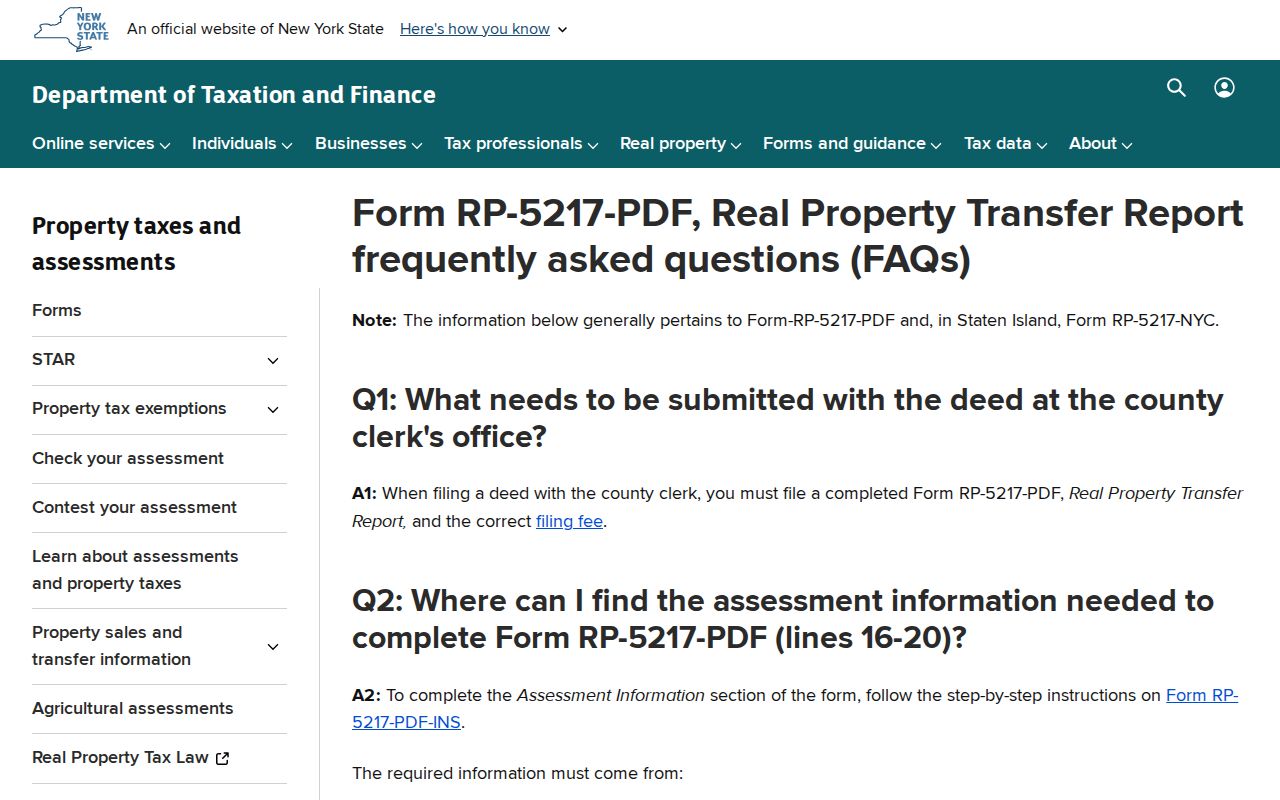
The image points to the official route for interpreting a reported sale. A deed date is not the price date.
Review and Challenge a Seneca County Assessment on Time
New York's local calendar puts tentative rolls and assessor review in the spring. Grievance Day is often the fourth Tuesday in May. Local dates can differ. Verify the municipality's roll date and hearing schedule. Start with an informal assessor review when one is offered, then use Form RP-524 with the local Board of Assessment Review for a formal complaint. Evidence should target the parcel and valuation date. Comparable sales, an appraisal, photographs, factual errors, income or cost data where relevant, and the challenged assessment records all belong in the file. The official New York grievance procedure page is the controlling source for the full process.
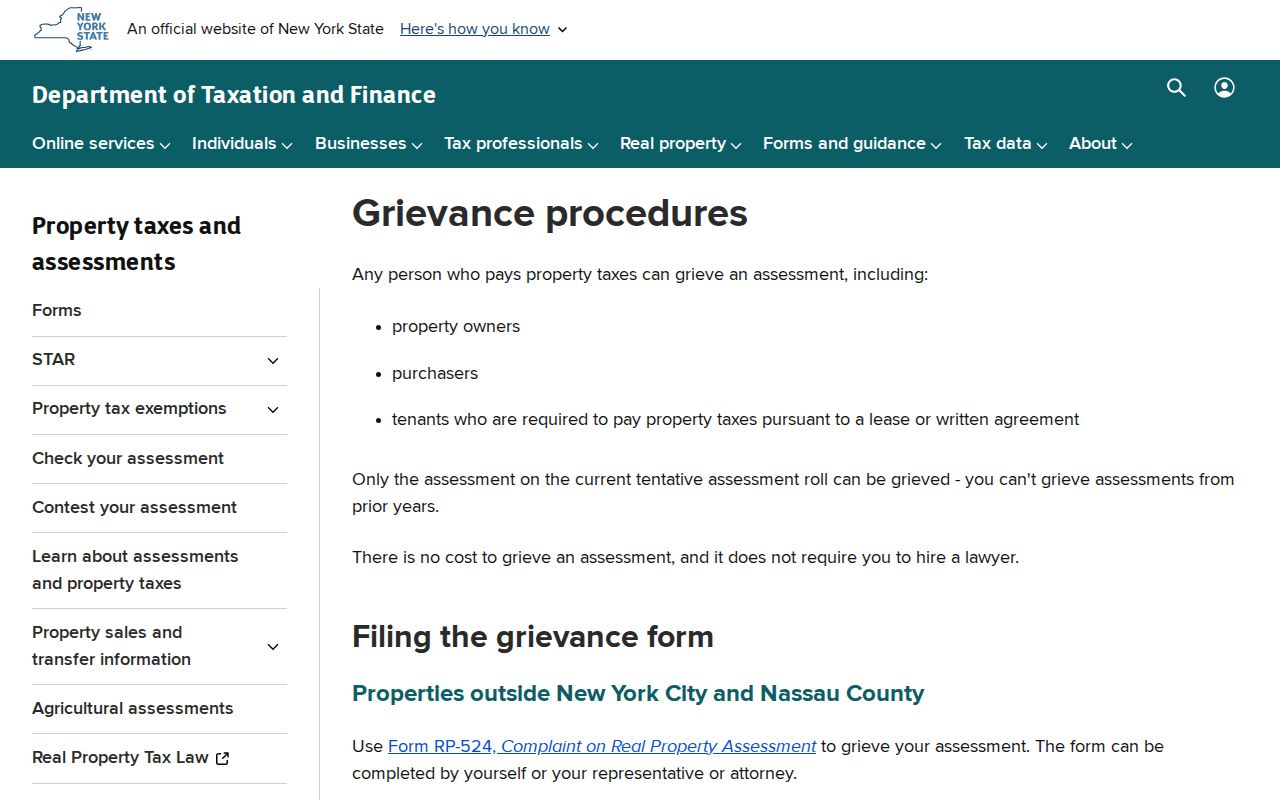
The state page explains the RP-524 route. The local assessor sets the controlling Seneca County filing date and meeting details.
Check the local deadline. A missed assessment-review date can limit the ordinary challenge route even when the owner has strong value evidence.
Exemptions Change Taxable Treatment, Not the Recorded Deed
An exemption changes how the tax roll treats a qualifying owner or use. It can shrink the taxable amount. It cannot rewrite a deed. Nor does it settle title or prove that the named taxpayer lives on the parcel. Read the exemption name, the amount or percentage, the tax year, and the jurisdiction exactly as the current Seneca County roll states them, then ask the assessor about the application, eligibility rules, renewals, and deadlines that apply locally. An exemption code alone never establishes a protected fact about a person.
Mailing and situs fields answer different questions. Tax mail may go to an out-of-county owner, a post office box, an LLC agent, a fiduciary, or a service address. Keep the public field as written. Do not turn it into a claim about where someone resides. If a protected address is withheld under New York's Address Confidentiality Program or another law, treat the absence as intentional rather than as a gap to work around.
Trace Delinquency, Liens, and a Seneca County Tax Sale Carefully
A late bill is not a finished foreclosure. It is also not a transfer of title. For bill status, use the collector and the Treasurer. For recorded filings, use the County Clerk's Tax Liens and Consolidated Liens offices. For litigation and sale notices, rely on court or Sheriff sources. County financial material describes how unpaid school taxes and county collection duties get handed off. But the county publishes no stable public list of all delinquent parcels. Request an official status tied to the specific parcel and year.
When a sale or foreclosure is alleged, track down the notice, the case, the judgment, the terms, and the resulting deed. A lis pendens only proves litigation was noticed. It does not show that the plaintiff won or that ownership changed. A Sheriff notice announces a planned event. So confirm whether it happened and whether a deed was recorded afterward. Liens can also be released later. The full record sequence in Seneca County property records matters far more than a single search hit.
Historic Seneca County Tax and Map Sources Add Time Depth
Older tax lists and maps can tie a former owner to a present-day parcel. They can also anchor an old farm. A BGSU finding aid catalogues regional material. It spans nineteenth-century tax-list, survey, plat, court, and recorder records for the region. County map sheets cover Waterloo, Ovid, Seneca Falls, and other towns. They span several nineteenth-century dates. Treat an old owner label or road name as a discovery clue only. Then reconcile it against the current parcel number. Check the deed chain too. A historic map does not fix today's surveyed boundary. An old tax entry is no substitute for the modern Seneca County tax roll.
For a focused request, supply the current and former address, the parcel number, the municipality, the owner of record, and the tax year. Also say whether you want a roll entry, bill, status report, map, exemption file, or certified copy. New York FOIL reaches existing agency records subject to its exemptions. It does not force an office to build a new tax analysis. The Seneca County property value guide sorts out how assessed value, market value, and recorded sale consideration differ. It does not rebuild the whole bill workflow.
Reconcile a Seneca County Tax Record With the Parcel
Compare nothing until the details line up. Confirm that the parcel number, municipality, owner field, and tax year all match. A split or merger can leave an older bill on a predecessor parcel. A recent deed may name a new owner before the next roll appears. When numbers refuse to align, ask the assessor for parcel history and the collector for year-specific status.
Keep school, county, town, and village charges inside their stated periods and jurisdictions. A paid status on one bill says nothing about another year's charge or a separately recorded tax lien. For any formal use, request the office's current report or certified record. Preserve the date it was issued.
Requesting a historic roll or bill? Name the tax year instead of calling the record simply old. Ask whether the response reflects the original charge or later adjustments. Also ask about exemptions, penalties, and payment status. Keep the issue date, because collection facts can shift after a report is produced.
Run any tax comparison on one year and one jurisdiction across every row. Mixing a tentative assessment, a final roll, and a later bill is one mistake. It invents a difference that does not exist. Label each figure precisely. When a portal shows multiple years, ask the assessor which roll controls.